
Bullpen Usage: The Hidden Factor in MLB Strikeout Props
 Available in US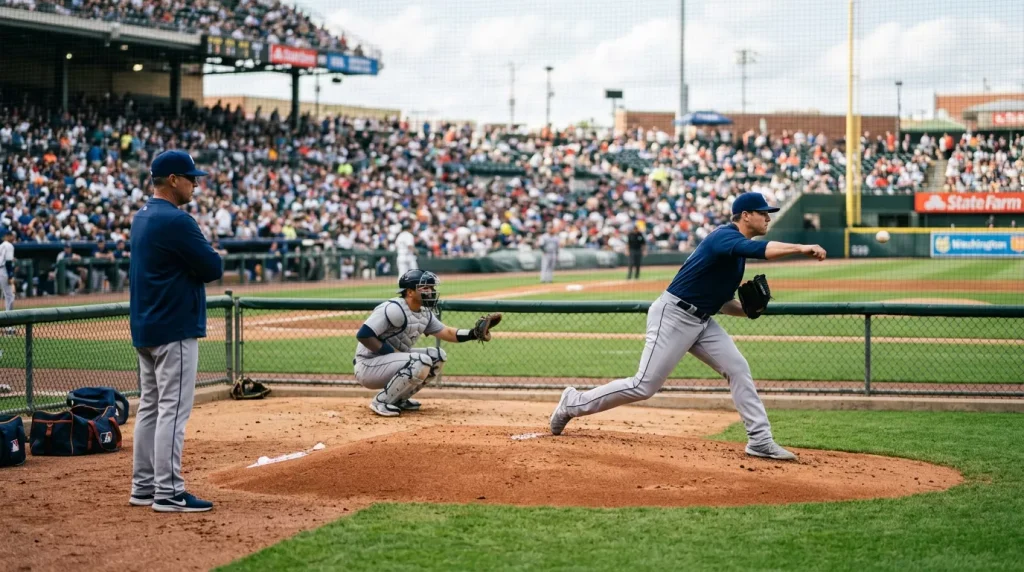
Contents
The Sunday I learned to read the previous night’s box score
For two seasons I bet K-prop overs on starting pitchers without ever checking how the bullpen behind them had been used. Most weeks that worked. One Sunday in particular it did not — a 12-inning game on Saturday had emptied half the bullpen, and the starter I had backed for Sunday was being asked to go deeper than usual to protect tired relievers. He got pulled at 90 pitches anyway, because the team had a doubleheader Monday. The bet died not on his stuff but on the bullpen calendar around him. I have read the previous night’s box score for every prop bet ever since.
Bullpen usage is the invisible variable on every pitcher prop. The book prices it. Sharp money tracks it. Recreational bettors mostly ignore it. The information is publicly available — you just have to look at the last 24 to 72 hours of relief appearances for the team and ask what that implies for tonight’s K-prop line.
See also: best mlb player prop bets — bullpen usage impact.
Modern leash trends — shorter, then shorter again
The era of the 200-inning workhorse starter is essentially gone. Modern managers pull starters at consistent points, typically 85 to 100 pitches, regardless of how the starter looks. The league-average qualified starter goes 4.8 innings per start, which is the structural backdrop for every K-prop line. Pitchers are not being asked to chase strikeouts deep into games anymore; they are being asked to be efficient inside their assigned workload window.
The K-prop implication. A pitcher’s K-prop line is set in part on the assumption that the manager pulls him at his usual point. If the bullpen is depleted and the manager has to extend the starter, K-prop overs become more reachable, but injury risk rises. If the bullpen is fresh and the manager has shorter-than-usual hooks lined up, K-prop overs become harder to clear because the starter does not get enough innings to accumulate the strikeouts.
Garrett Crochet’s American League-leading 255 strikeouts in 2026, paired with an AL-best K/9 of 11.2, were built on a strong workload pattern within these modern norms. The strikeout-rate efficiency, not the innings volume, was what carried the season total. That model — efficient strikeout accumulation inside a managed workload — is now the template for every elite starter.
Why relievers actually bring more strikeouts per inning
The unspoken truth that recreational bettors miss. Relievers, on a per-inning basis, strike out hitters at higher rates than starters do. The reason is straightforward. A reliever throws max-effort for an inning or two; he does not need to pace himself. He often features a two-pitch arsenal at peak velocity, against hitters who get one or two looks rather than three or four.
The league-average reliever K/9 sits noticeably above the qualified starter average of 8.3. Elite relievers can post K/9 figures above 13, sometimes 14 — well into the range that no starter sustains across 200 innings. That gap means a game where the bullpen takes over early features more strikeouts in the late innings than a game where the starter goes deep.
The prop implication for team-strikeout markets. A game with an early hook for the starter is a positive signal for team-K-prop overs, because the relievers replacing the starter typically strike out hitters at a higher rate than the starter would have. For individual-pitcher K-props, the same dynamic is bad for the starter’s prop because he loses the opportunity to accumulate strikeouts. The two markets move in opposite directions on the same cue.
Opener games and what they do to K-prop lines
Opener games — where the team starts with a one-inning reliever and a “bulk” pitcher takes over from the second inning — have become a regular feature of MLB scheduling. The K-prop landscape for these games is structured differently from a normal start, and the bookmaker line shape reflects it.
The opener pitches one inning, often three to four batters faced, and his K-prop line is microscopic — typically set at 1.5 or 2.5. The bulk pitcher’s line is set as if he were a starter beginning in the second inning, with the corresponding lower innings budget. The combined team K-total line accounts for both. Each is a different bet.
The most consistent K-prop edge in opener games is on the bulk pitcher’s over when he is high-K-rate. The bookmaker often prices the bulk line conservatively because the bulk role is less data-rich than a typical starting role. A high-K reliever-turned-bulk-pitcher facing a strikeout-prone lineup is the canonical soft K-prop over of the slate.
Back-to-back bullpen days
The pattern that compounds. A team that has used three or more relievers for multiple innings each on Saturday is operating on a depleted bullpen for Sunday’s game. Manager decisions on Sunday account for this. The starter gets a longer leash to protect tired arms; the relievers who pitched short bursts on Saturday are unavailable; the relief options who do pitch are often the lesser arms.
The K-prop implications cut both ways. The starter on Sunday is more likely to clear his K-prop over because he is being asked to go longer. The relievers used on Sunday are lower-K-rate options than the team’s typical leverage arms, which means team K-prop totals can come in below the typical level even if the starter is efficient.
The Statcast-era benchmarks help calibrate this — league-average qualified starter at 8.3 K/9, 25 per cent whiff rate, 29 per cent chase rate, 4.8 innings per start. When a starter’s workload is extended by 1.5 innings beyond his usual length because of bullpen depletion, the K-prop over becomes meaningfully easier to clear; his K/9 may dip a touch from fatigue, but the extra batters faced more than compensate.
Betting around the bullpen
The information sources to lock in. The previous 24 to 72 hours of relief appearances are visible in any box score. The team’s expected available bullpen for tonight is sometimes reported by beat writers; if not, you have to infer from the pattern of usage. A team coming off a doubleheader is bullpen-depleted by definition. A team with a fresh off-day yesterday has a fresh bullpen tonight.
The bet construction routine. For each pitcher prop candidate, check the team’s bullpen workload over the previous 48 hours. If depleted, lean toward starter K-prop overs and reliever K-prop unders. If fresh, lean toward starter K-prop unders (because of quick hooks) and team K-prop overs (because rested relievers are typically high-K options).
See also: MLB strikeout prop bets with full market coverage.
The pre-bet check on workload also pairs with the workload-driven view of pitcher outs-recorded lines. The two markets share the same information backbone, and reading them together is the natural workflow. For the times-through-the-order side of the equation that determines when the manager actually pulls the starter, my walkthrough on TTO and pitcher prop value is the natural pairing.
The bullpen habit that costs nothing
The discipline I want to encourage. Take 60 seconds before every pitcher prop bet to check last night’s bullpen usage for the relevant team. The information is free. It changes how you read the K-prop line in front of you. The bookmaker has the information too, but the lines are set in advance and updated less often than the workload picture shifts. That latency is the gap. The bettors who routinely check the previous 48 hours of relief work are positioning themselves on the side of the line where the information is fresher than the price.
