
Umpire Strike Zones and MLB Strikeout Prop Bets
 Available in US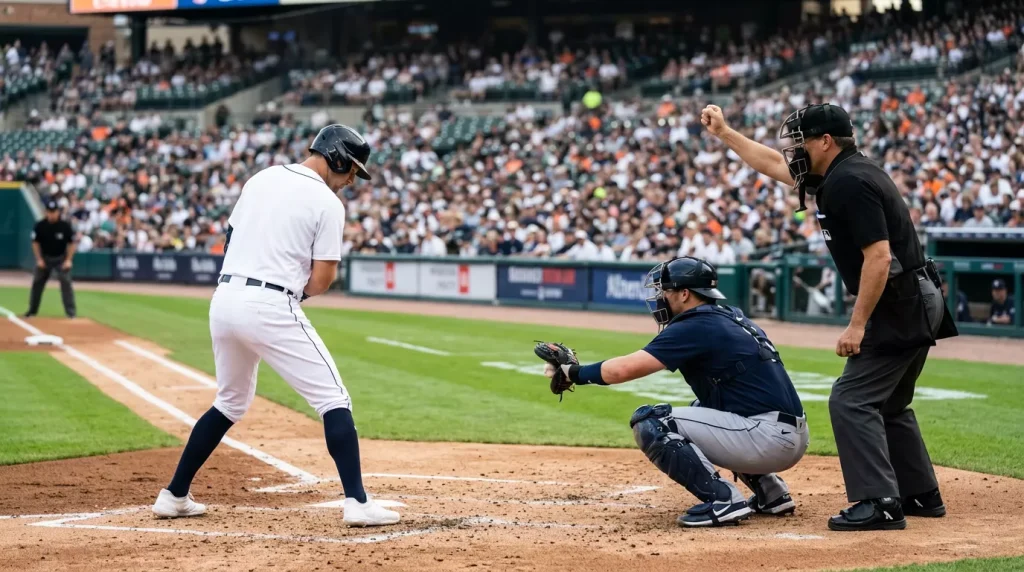
Contents
The variable that should appear in every prop guide and rarely does
Behind every pitch decision and every strikeout call sits a single human umpire who decides what constitutes a strike. The strike zone is defined in the rulebook, but in practice it varies meaningfully from umpire to umpire. Some umpires are notoriously generous to pitchers — calling strikes on pitches an inch or two off the corner. Others are tight — squeezing the zone and forcing pitchers to throw down the middle. The difference between the most generous and the tightest umpire on a typical slate is large enough to shift expected strikeout totals by one or two per game. That is not a footnote; that is a bet.
The bookmaker prices the umpire into the line, in theory. In practice, the umpire assignment is sometimes announced after the prop lines are posted, and the market adjusts more slowly than the underlying probability changes. That latency is the spot I aim to live in.
See also: best mlb player prop bets — umpire zones.
How the strike zone varies by umpire
The strike zone in MLB is supposed to span the width of home plate (17 inches) and vertically from the midpoint between the shoulders and the top of the trousers to the bottom of the kneecaps. In practice, called strikes happen on pitches measurably outside that rectangle, particularly at the corners. The deviation from the rulebook zone varies by umpire, by count situation, and by pitch type.
The cleanest variable to track is called-strike rate on close pitches. Some umpires call called-strikes on roughly 50 per cent of borderline pitches in a season; others call called-strikes on 60 per cent or higher. That 10-percentage-point gap is the difference between a generous zone and a tight one. For a starter with a high SwStr% of 12 to 13 per cent and a strong chase rate above 32 per cent, a generous umpire amplifies his strikeout output meaningfully. For the same pitcher with a tight umpire, the chase rate gets neutralised — hitters do not need to chase as much because the called-strike threat is less credible.
League-average qualified starters operate at roughly a 25 per cent whiff rate, a 29 per cent chase rate, and 8.3 K/9. The umpire variable can shift the effective K/9 for a single start by half a strikeout in either direction. Across multiple starts in a season, that compounds substantially.
Tight versus loose umpires
The classification I use. Loose umpires — those who call strikes generously, particularly at the lower edges and corners — favour pitchers who work the edges. These are typically the breaking-ball-heavy starters, the curveball specialists, the pitchers whose stuff plays at the corners rather than down the middle. With a generous umpire, their chase rate effectively rises because hitters know the umpire is calling pitches just off the corner; they have to expand to protect.
Tight umpires — those who squeeze the zone, particularly on the inside corner and below the knees — favour hitters and especially patient hitters. Pitchers are forced to throw pitches over the heart of the plate, and hitters get more pitches to hit. The walk rate for both sides creeps up; strikeout rate falls.
The 2026 K-leaders included Dylan Cease at an MLB-leading 11.5 K/9 and Garrett Crochet at the AL-leading 255 strikeouts on an 11.2 K/9. Both of those pitchers maintain strong K-rates across umpire types because their swing-and-miss generation is independent of the called-strike zone — they get strikeouts through stuff, not through borderline calls. The umpire variable matters more for pitchers in the 8.5 to 10 K/9 range, where the marginal called strikes can swing the bet.
Umpire and pitcher edge
The interaction between umpire profile and pitcher arsenal is where the actionable edge lives. A generous-zone umpire paired with a pitcher who has both a high SwStr% and a high chase rate is a multi-input K-prop over. The pitcher already gets whiffs; he already gets chases; now he gets called strikes on the edges as well. The K-prop ceiling rises.
The opposite — a tight-zone umpire with a control-artist starter who works the corners — is the canonical K-prop under candidate, even when the pitcher’s nominal K/9 looks strong. The pitcher cannot get his typical called-strike count because the umpire is squeezing. He compensates by throwing more pitches over the plate, which produces contact rather than misses. The K total drops.
The implication for prop selection. Cross-reference the announced umpire with the starter’s profile before placing the bet. If the umpire is on the generous end and the pitcher has a corner-attacking arsenal, the K-prop over is more attractive than the line implies. If the umpire is tight and the pitcher is a corner-artist, the under is more attractive. The market often does price this, but not always with sufficient sharpness.
Umpire and walks props
The walks-prop market also shifts with umpire profile, in the opposite direction from strikeouts. Tight umpires produce more walks across the slate. Loose umpires suppress walk rates. A wild pitcher paired with a tight umpire is the recipe for a walks-prop over; the same wild pitcher with a loose umpire often gets bailed out by called strikes on borderline pitches that would otherwise be ball four.
The most useful cross-application. When a high-chase-rate pitcher is on the mound with a tight umpire, his typical walk rate compresses upward — he cannot get the called strikes he relies on, so his pitch count climbs, his hooks come earlier, and his walk total rises. Both the walks-prop over and the outs-recorded under become viable in the same start.
Using umpire data pre-bet
The pre-bet routine. After the home-plate umpire assignment is announced for each game on the slate, check the umpire’s called-strike rate on borderline pitches over the previous two seasons. Categorise as generous (above 55 per cent), neutral (50 to 55 per cent), or tight (below 50 per cent). Cross-reference with each pitcher’s arsenal — corner-attacker, swing-and-miss artist, or contact-manager.
The pricing dimension. The market sometimes incorporates the umpire after announcement; sometimes it does not move noticeably. The window of opportunity is the time between umpire announcement and line adjustment. If the K-prop line is unchanged after a generous-zone umpire is announced to call a game featuring a corner-artist starter, the over is structurally underpriced for the duration of that window.
For the deeper view of pitcher metric reading that this umpire layer builds on, my guide to K/9, SwStr%, and chase rate for MLB strikeout props is the natural prerequisite.
See also: bullpen usage and MLB strikeout props.
The umpire habit that pays slowly
The summary. The umpire variable is one of the genuinely overlooked inputs in retail MLB prop betting. The bookmaker has the data; the recreational money rarely consults it. The bettors who build a routine of checking the home-plate umpire’s strike-zone profile alongside the pitcher’s arsenal are operating with a small information advantage that compounds. The edge per bet is modest, perhaps a few percentage points of implied probability, but it appears consistently and on the soft side of the market. Quiet edges are the only kind that stay edges; the loud ones get priced out within a season. Umpire profiles fall into the quiet category, and have for years.
