
Day vs Night Games: How Lighting Shifts MLB Player Prop Value
 Available in US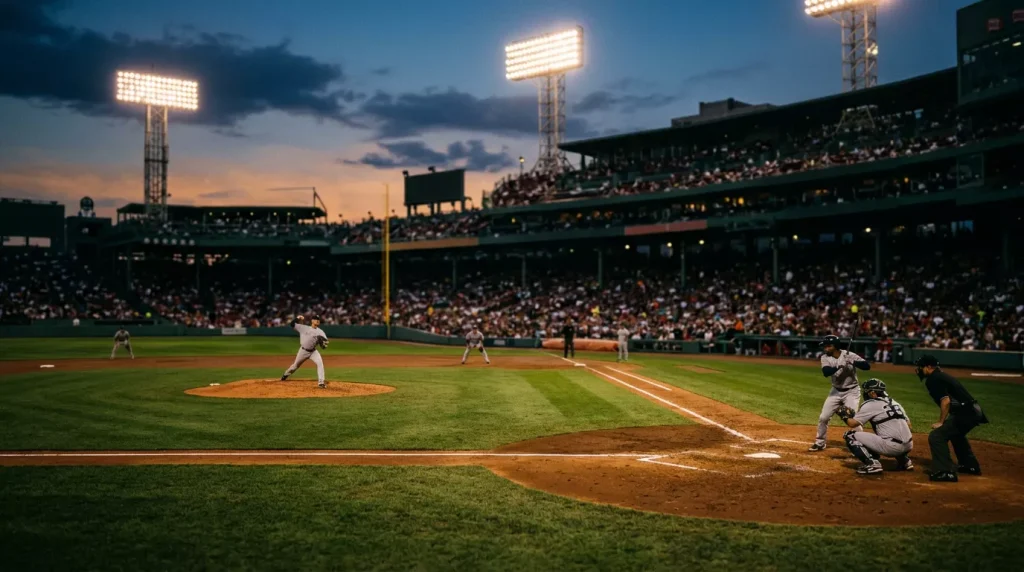
Contents
The getaway-day discovery that paid for itself
One Thursday afternoon I noticed something. Three teams were on getaway days — the last game of a series before flying out. The lineups were all noticeably tilted toward bench players and platoon options. The bookmaker prop lines, however, were set as if it were just another game. That Thursday I made my first deliberate getaway-day prop play. It hit. The next month I tracked the pattern and found the edge was real and quiet. Day games and night games are not the same product, and getaway days are not the same as midweek slates. The market sometimes prices the difference. Often it does not.
The lighting, the schedule fatigue, the lineup composition — all of it shifts prop value in ways that recreational bettors rarely account for. The bettor who learns to read these cues finds an angle that does not depend on superior statistical models or insider data. It just depends on paying attention to context.
See also: best mlb player prop bets — day vs night splits.
Why day games are structurally different
The most obvious variable is light. Day games happen in natural sunlight, which produces shadows that move across the infield as the game progresses. The shadows that fall across home plate at certain times in the afternoon are notorious for hindering hitter vision — particularly in early-spring and autumn games where the sun angle is low. A pitcher’s fastball hidden in shadow is harder to track than the same pitch under uniform stadium lights.
The second variable is schedule. Day games typically follow night games, which means players are operating on shorter rest. Hitters who played a 4-hour game ending at 11 pm and are then asked to play a 1 pm matinee are not at full capacity. Starting lineups account for this by giving regulars off-days more frequently on day games following nights.
The third variable is body clocks. Many MLB players are nocturnal by professional habit. They wake at 11 am, hit the field at 4 pm, play until 11 pm, eat at midnight, and sleep at 2 or 3 am. A 1 pm first pitch disrupts the entire rhythm. Hitter timing, in particular, takes more time to settle in day games. Strikeout rates run higher in the early innings of day games for that reason alone.
Day game hitter statistics
Across the league, hitter performance in day games is broadly weaker than in night games. Strikeout rates run a touch higher, walk rates slightly lower, and run-scoring is meaningfully reduced. The reasons compound — shadows, fatigue, body-clock disruption. None of those things move very far on any single day, but they add up across an entire game.
Cal Raleigh’s record-setting 60-home-run season in 2026 — the seventh player in history to reach 60 — was not built on any obvious day-night split, but the league-average pattern means that even elite power hitters take a small probability hit on day games versus their night-game baseline. The smart bettor adjusts the implied probability downward by a few percentage points for day-game HR-props, especially for hitters whose pre-game preparation time is compressed by short rest.
The biggest day-night gap I have found is in early-game offence — first three innings — which run consistently lower in day games. Hitters need a couple of at-bats to acclimate to the lighting. By the late innings, the day-night gap narrows.
Day game pitcher statistics
The mirror image. Pitchers, on average, perform slightly better in day games. The strikeout rate ticks up a touch, the walk rate drops, the hard-contact rate is suppressed. Some of this is the inverse of the hitter effect, and some of it is selection — pitchers who start day games tend to be regular rotation members, not openers, because clubs prefer their established arms for the lighting-disadvantaged offence.
The implication for K-prop overs in day games. Starting pitchers with elite K-rates get a small tailwind from the day-night effect, layered on top of their underlying stuff. The over often clears more consistently than the pitcher’s season K-rate alone would suggest. K-prop overs in day games are a category I look at favourably as a baseline.
Dylan Cease’s 11.5 K/9 — the highest in MLB in 2026 — sits at a level where the day-night premium becomes nearly irrelevant; he gets strikeouts in any environment. But for the next tier of K-prop starters, the day-game multiplier can be the variable that pushes the bet from a marginal hold to a clear over.
Getaway days and lineup rest
This is where the edge gets sharp. Getaway days — the last game of a series before a team travels — are systematically used by managers to rest regulars and play bench depth. The starting lineup on a getaway day, particularly when it is also a day game, can look very different from a Tuesday lineup at the same park.
The integrity scrutiny on player props has reinforced how much these contextual signals matter, because props that depend on individual outcomes are easier to fix than multi-actor markets. As the Commissioner of Baseball put it on the league’s monitoring relationship with sportsbooks, Once you’re in that environment where sports betting is happening, the crucial issue is access to data.
Reading getaway-day lineup decisions is itself a form of reading data — and unlike pitch-by-pitch micro-data, lineup announcements are public and unmanipulable. That makes them an ideal input for a disciplined prop process.
The pattern. The starting lineup on a getaway day typically includes one or two bench players who would not normally start. The top hitters get the day off; the platoon side that does not fit the day’s opposing pitcher gets benched. Prop bets on the regulars are removed from the slate entirely. Prop bets on the bench players who do start are typically priced poorly, because the bookmaker has less data on them and often sets a default line.
Applying day-night to bet construction
The pre-bet routine. For each prop candidate, check whether the game is a day game or a night game. If day, slightly downgrade the HR-prop probability for hitters and slightly upgrade the K-prop probability for pitchers. If the day game is also a getaway day, check the announced lineup first; do not bet on a hitter who turns out to be benched, and look for bench-player props as potential value spots.
The benchmark for a hot-form hitter — exit velocity above 90 mph, barrel rate above 15 per cent, xwOBA above 0.370 over 40-plus plate appearances — still applies in day games, but the absolute level of his HR-prop probability is a touch lower than in the same matchup played at night. The hitter is still the hitter; the environment is the variable.
The other major application is timing your in-play action. Day-game first innings are systematically lower-scoring than late innings; in-play markets that re-price after the first inning sometimes overcorrect to the day-game effect. For a deeper look at the rhythm of live betting on MLB props, my walkthrough of MLB live in-play prop betting is the natural next step.
See also: platoon splits for MLB player props.
The lighting check that costs nothing
The simple discipline. Before every prop bet, take five seconds to check whether the game is a day or night game, and whether it is a getaway day. The check is free. The information feeds directly into how to size and select the bet. Day games are a small but consistent pricing inefficiency, and the bettors who pay attention to lighting are the ones who pay attention to most of the small things that compound into long-run edge. The market is not always wrong about day-night context — it is just slow to fully price it for less-prominent players, and that lag is the gap I aim to live in.
